
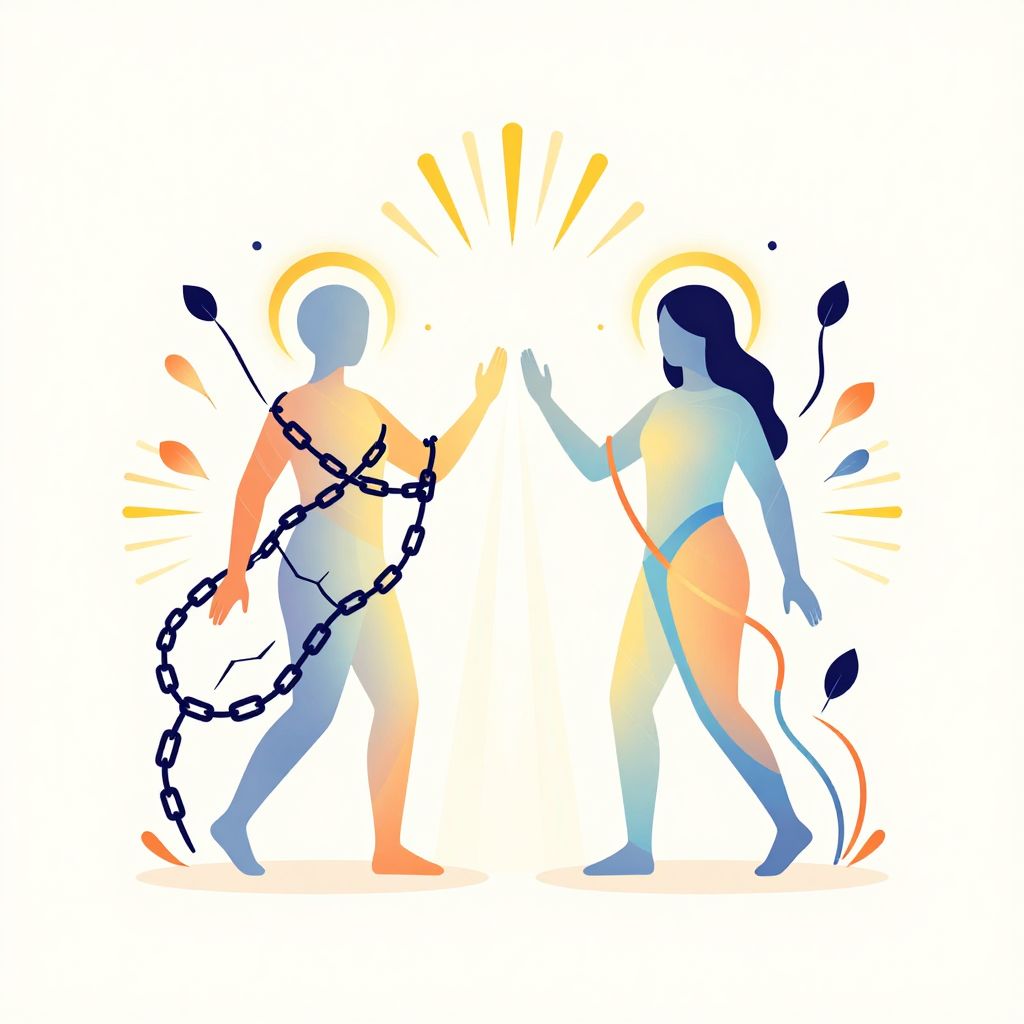
You know that strange gravitational pull toward someone who no longer belongs in your life? That mental loop where their name shows up in your thoughts even when you don’t want it there? Psychology calls this rumination and attachment, but many people recognize it as something deeper: a soul tie that won’t let go.
Soul ties describe emotional and psychological bonds that persist long after a relationship ends. Breaking them requires deliberate action across cognitive, behavioral, and relational domains.
How Do You Break Soul Ties?
You break soul ties through deliberate physical separation, cognitive restructuring, emotional processing, and the intentional redirection of mental and behavioral patterns. This process combines removing environmental triggers, disrupting thought patterns through awareness techniques, processing unresolved emotions, and replacing old relational patterns with new, healthier connections and habits.
1. Remove Physical and Digital Reminders
The brain forms associative memories that link objects, places, and digital content to emotional states. Research in memory reconsolidation shows that environmental cues reactivate neural patterns associated with past relationships, making emotional detachment nearly impossible when reminders saturate your space.
Physical objects carry emotional weight because your brain encoded them during moments of significance. That shirt, those photos, the gift you kept on your desk all serve as retrieval cues that pull up entire emotional networks.
Take these concrete steps:
- Box up items connected to the person and store them out of sight, or donate them entirely
- Unfollow, mute, or block their social media profiles to eliminate digital exposure
- Delete text threads, photos, and other digital traces from devices you use daily
- Change routines that involve places you frequented together
This isn’t avoidance. It’s removing the environmental friction that keeps old neural pathways active.
2. Establish Complete Contact Boundaries
Intermittent reinforcement is one of the most powerful conditioning mechanisms in behavioral psychology. When contact with someone happens unpredictably, your brain treats each interaction like a reward you can’t anticipate, which actually strengthens attachment rather than weakening it.
Texting occasionally, checking in “as friends,” or maintaining ambiguous communication creates what researchers call partial reinforcement schedules. These make bonds harder to break than consistent contact would.
Set a firm boundary: no contact for a defined period, typically 60 to 90 days minimum. Communicate this boundary once if necessary, then maintain it without explanation or negotiation.
This isn’t cruelty. It’s creating the psychological space required for your nervous system to recalibrate and for new neural patterns to form without constant reactivation of the old ones.
3. Interrupt Rumination Patterns
Rumination is repetitive thinking about the same person, event, or emotional experience. It’s a mental loop that feels productive but actually deepens emotional grooves.
Yale researchers studying Default Mode Network activity found that rumination keeps specific neural circuits firing, which reinforces the emotional significance of whatever you’re ruminating about. Your brain literally strengthens what you repeatedly think about.
When you notice yourself thinking about the person, use these interventions:
- Name the pattern aloud: “I’m ruminating again”
- Redirect attention to a specific, engaging task that requires focus
- Use the “thought diffusion” technique: imagine the thought as a leaf floating down a stream, observable but not something you grab onto
- Set a five-minute timer and allow yourself to think about them fully, then move on when it rings
These techniques work because they interrupt automaticity. You can’t stop thoughts from arriving, but you can stop feeding them attention.
4. Process Unresolved Emotions Actively
Soul ties often persist because of emotional incompleteness. The relationship ended, but the feelings didn’t get processed, expressed, or understood.
Research in affective neuroscience shows that suppressed emotions don’t disappear. They remain active in subcortical regions and influence behavior, mood, and attachment without conscious awareness.
Emotional processing means feeling what’s actually there without immediately trying to fix, avoid, or explain it away. Journaling serves as one of the most effective tools for this.
Write without editing: what you felt, what you wish you’d said, what you’re angry about, what you miss. This externalization helps the brain categorize and store emotional experiences as memory rather than keeping them active as present-tense distress.
If the emotions feel overwhelming or unmanageable alone, working with a therapist trained in emotion-focused approaches provides structure for this process. Unprocessed emotion keeps you tethered; processed emotion sets you free.
5. Rewrite the Narrative
Human beings are meaning-making creatures. You don’t just remember events; you tell stories about them.
Narrative psychology research demonstrates that the stories you construct about your relationships shape your identity, your expectations, and your future behavior. If you keep telling yourself this person was “the one,” or that you’ll never find that connection again, you wire those beliefs into your operating system.
Rewriting the narrative doesn’t mean lying to yourself. It means examining the story for completeness and accuracy.
Ask yourself: What did this relationship teach me about my needs? Where did I abandon my boundaries? What patterns do I want to change? What am I now free to pursue that I couldn’t before?
Write a new story that includes the hard parts but doesn’t idealize what’s gone. Include what you learned, what you’re taking forward, and what you’re intentionally leaving behind.
6. Redirect Energy Into New Patterns
Breaking a soul tie creates a vacuum. Your time, attention, emotional energy, and mental space previously occupied by this person suddenly open up.
Behavioral activation, a core principle in cognitive-behavioral therapy, shows that mood follows action more reliably than action follows mood. Waiting until you feel ready to move on keeps you stuck; moving on through deliberate behavior creates the feelings you’re waiting for.
Choose specific, concrete activities:
- Start a physical practice like running, yoga, or strength training that connects you to your body
- Commit to a creative project with a clear outcome
- Deepen existing friendships through consistent, planned time together
- Learn a skill that requires progressive difficulty and feedback
These activities aren’t distractions. They’re the raw material your brain uses to build a new sense of self and a new relational baseline.
7. Examine the Underlying Attachment Style
Soul ties don’t form equally with every person. Some relationships leave clean breaks; others leave you tangled for years.
Attachment theory, developed through decades of research starting with John Bowlby and Mary Ainsworth, reveals that early relational experiences shape how you bond, how you handle separation, and how you regulate distress. If you have an anxious attachment style, for example, you’ll experience relationship endings as threats to survival, which intensifies the bond even when the relationship was unhealthy.
Understanding your attachment pattern gives you insight into why this particular tie feels so hard to break. It’s not that the person was uniquely special; it’s that your nervous system registers separation as danger.
Secure attachment develops through new relational experiences that provide consistency, safety, and attunement. Therapy, stable friendships, and even relationships with pets or communities can gradually reshape these patterns.
8. Build Closure Internally
Many people wait for external closure: the conversation that explains everything, the apology that heals, the mutual agreement that the relationship is truly over. This rarely comes, and waiting for it gives another person control over your healing timeline.
Closure is an internal process, not an external event. You create it by deciding the relationship is complete, even if it feels unfinished.
Write a letter you’ll never send. In it, say everything you need to say: the anger, the gratitude, the confusion, the goodbye. Then burn it, bury it, or delete it.
This ritual signals to your brain that something has ended. Rituals work because they provide symbolic completion when literal completion isn’t available.
Why Soul Ties Form in the First Place
Understanding why these bonds develop helps you break them with more precision. Soul ties aren’t mystical accidents; they’re psychological and neurological realities.
Neurochemical Bonding
Intimate relationships flood the brain with oxytocin, dopamine, and endorphins. These neurochemicals create feelings of trust, pleasure, and attachment.
Research in affective neuroscience shows that your brain doesn’t distinguish between healthy and unhealthy sources of these chemicals. If someone provided intense emotional experiences, good or bad, your brain bonded to them as a significant stimulus.
Unmet Needs and Trauma Bonding
When someone meets a deep, previously unmet need, or when a relationship cycles between pain and relief, the bond intensifies. This is especially true in trauma bonding, where intermittent reinforcement and unpredictability create powerful, difficult-to-break attachments.
Recognizing trauma bonding reframes what feels like love into what it actually is: a conditioned response to chaos. This recognition is the first step toward freedom.
Identity Fusion
Some relationships become so enmeshed that you lose track of where you end and the other person begins. Your goals, your preferences, your daily rhythms all organize around them.
When the relationship ends, you’re not just losing a person. You’re losing the version of yourself that existed in relation to them. Rebuilding requires reconstructing identity from the ground up.
What Happens When You Successfully Break a Soul Tie
Breaking a soul tie isn’t a single moment of release. It’s a gradual process with recognizable markers.
You’ll notice you can go hours, then days, without thinking about them. Their name won’t spike your nervous system when you hear it.
You’ll stop checking if they’ve viewed your social media. You’ll stop mentally rehearsing conversations you’ll never have.
Most significantly, you’ll feel the return of your own energy. The mental and emotional resources you were spending on maintaining that connection become available for your actual life.
You’ll start imagining a future that doesn’t include them, and that future will feel open rather than empty. Maybe even a little exciting.
Common Mistakes That Keep You Tied
Breaking soul ties fails most often because of predictable errors. Awareness of these helps you avoid them.
Staying “Friends” Too Soon
Friendship after a deep romantic or emotional relationship requires both people to have fully detached first. Attempting it prematurely just maintains the tie under a different label.
Real friendship becomes possible only after you’ve built a life that doesn’t need them in it. Until then, it’s just a way to keep the door open.
Using Someone New to Forget Someone Old
Rebound relationships don’t break soul ties. They layer new attachments over unresolved old ones.
You don’t need to wait forever before connecting with someone new, but entering a new relationship while still emotionally occupied by a past one creates unfair conditions for everyone involved.
Revisiting the Relationship Mentally
Fantasizing about reconciliation, imagining different outcomes, or mentally rewriting the past keeps the neural pathways active. You’re not remembering; you’re re-experiencing, which means you’re re-encoding.
Every time you vividly replay a memory, your brain treats it like a new experience. This strengthens rather than weakens the tie.
Moving Forward
Breaking a soul tie is an act of self-reclamation. You’re taking back the energy, attention, and mental space that belonged to someone who no longer serves your growth.
The process isn’t comfortable, and it doesn’t happen quickly. Healing operates on its own timeline, and trying to rush it usually just creates new problems.
Start with one clear action today. Remove their number from your phone. Box up the reminders. Write the unsent letter. Choose one intervention from this article and commit to it fully.
Soul ties break not through dramatic moments but through consistent, unglamorous choices repeated over weeks and months. You stop reaching out. You redirect your thoughts. You build a life that doesn’t include them.
One day, you’ll realize you’ve gone a week without thinking about them. Then two weeks. Then you’ll forget to count.
That’s when you’ll know the tie has finally broken. And what you’ll feel isn’t just relief—it’s the quiet, steady freedom of belonging fully to yourself again.
If you’re working through the challenge of moving on from someone who still occupies your thoughts, you might also find it helpful to explore practical strategies for how to stop thinking about someone and learn more about how to detach from someone in ways that support your emotional well-being and personal growth.