
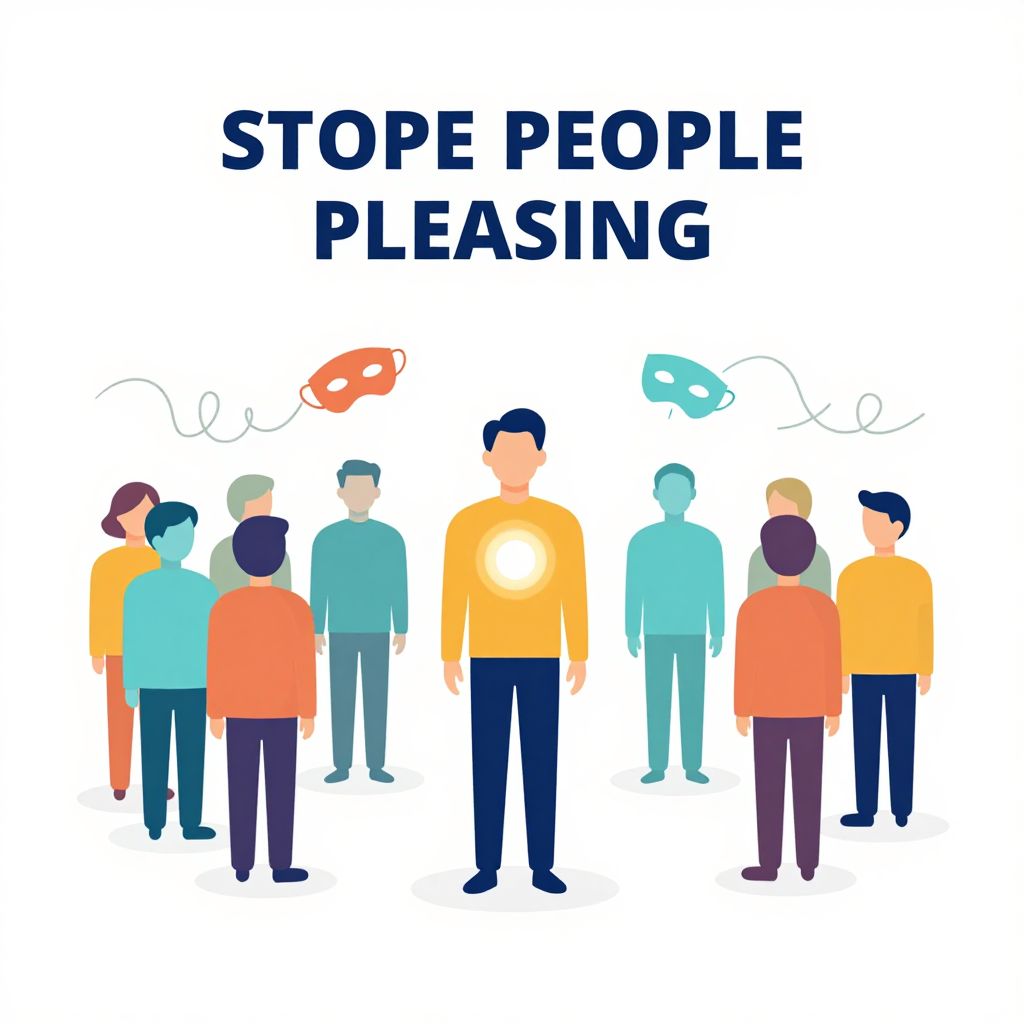
You agree when you want to say no. You smile when you feel uncomfortable. You prioritize everyone else’s needs and wonder why you feel exhausted, resentful, and invisible. People-pleasing isn’t kindness—it’s a pattern of self-abandonment disguised as generosity, and it quietly erodes your sense of self.
This article explores the psychological roots of people-pleasing and offers research-backed strategies to reclaim your boundaries, voice, and authentic presence. You’ll learn why this pattern develops, what maintains it, and how to dismantle it step by step.
How Do You Stop Being a People Pleaser?
You stop being a people pleaser by practicing boundary-setting, tolerating the discomfort of disappointing others, and consistently choosing authenticity over approval. This requires recognizing that your worth doesn’t depend on other people’s satisfaction and learning to validate your own needs without external permission.
Understanding the Psychology Behind People-Pleasing
People-pleasing often develops during childhood when approval becomes tied to safety or love. Children who learn that their needs are secondary—or that expressing them leads to conflict, withdrawal, or criticism—adapt by becoming hyper-attuned to others’ emotions and suppressing their own.
Psychologist Harriet Braiker identified this as a survival strategy that outlives its usefulness. What once protected you in an unpredictable environment becomes a cage in adulthood, where you sacrifice authenticity to avoid rejection that may never come.
The brain’s reward system reinforces this pattern. When you please someone and receive positive feedback, your brain releases dopamine. Over time, you become addicted to external validation and lose touch with internal signals about what you actually want or need.
The Hidden Costs of Chronic People-Pleasing
People-pleasing masquerades as selflessness, but it carries steep psychological costs. Research published in the Journal of Social and Clinical Psychology links chronic approval-seeking to higher rates of anxiety, depression, and burnout.
You also build relationships on false pretenses. When people only know the version of you that accommodates and agrees, they never meet the real you. This creates a painful isolation—you’re surrounded by people yet feel profoundly unseen.
Resentment accumulates quietly. Each time you say yes when you mean no, you betray yourself. That anger doesn’t disappear—it turns inward or leaks out in passive-aggressive behaviors that damage the very relationships you’re trying to protect.
Recognize the Patterns You’ve Been Running
Change begins with awareness. You can’t shift a pattern you don’t fully see.
Automatic Agreement Before Thinking
People-pleasers say yes before they’ve checked in with themselves. The response is reflexive, driven by anxiety rather than choice.
Notice when you agree immediately to requests. Does your body tense? Does a quiet “no” surface that you quickly silence? That internal conflict is data worth examining.
Over-Apologizing and Excessive Explaining
You apologize for existing. You preface requests with lengthy justifications, as if your needs require a defense lawyer to be valid.
Track how often you say “sorry” in a single day. Count the number of times you apologize for things that aren’t your fault—being in someone’s way, asking a question, having a preference.
Anxiety About Others’ Emotional States
You feel responsible for managing everyone’s comfort. When someone is upset, you assume it’s your job to fix it, even when their feelings have nothing to do with you.
This is called emotional over-responsibility. Psychologist Lindsay Gibson describes it as confusing empathy with obligation—you can understand someone’s feelings without being required to resolve them.
Difficulty Identifying Your Own Preferences
When asked what you want, you draw a blank. Years of prioritizing others’ desires have severed the connection to your own.
This isn’t indecisiveness—it’s self-erasure. Your preferences haven’t disappeared; they’ve been consistently overruled until the signal became too faint to hear.
1. Build Awareness Through Tracking
You can’t change patterns you operate on autopilot. Awareness breaks the automaticity.
For one week, keep a simple log. Each time you agree to something, pause and note: Did I want to say yes? What did I actually feel? What did I fear would happen if I said no?
This isn’t about judgment. You’re gathering evidence about your patterns. The goal is clarity, not immediate change.
Pay attention to physical cues. Your body often knows before your mind does—tension in your chest, a sinking feeling in your stomach, tightness in your throat. These sensations signal misalignment between what you’re saying and what you’re feeling.
2. Practice the Pause
People-pleasers respond immediately because silence feels dangerous. It isn’t.
Insert a buffer between request and response. When someone asks something of you, practice saying: “Let me check my schedule and get back to you” or “I need to think about that.”
This simple delay creates space for your authentic response to surface. It interrupts the automatic yes and gives you time to consult your actual capacity and desire.
The pause feels uncomfortable at first. You might worry the person will be annoyed or think you’re difficult. That discomfort is the exact sensation you need to learn to tolerate—it’s the border between people-pleasing and authenticity.
3. Start With Low-Stakes No’s
You don’t begin by setting boundaries with your most intimidating relationships. You start small and build the muscle.
Decline minor requests where the stakes are genuinely low. Say no to the extra side of sauce. Choose the movie when it truly doesn’t matter to the other person. Express your actual preference for where to sit.
These micro-moments train your nervous system to tolerate the discomfort of potential disapproval. Each small no proves that rejection isn’t fatal and that relationships can survive your honesty.
Research on behavioral exposure confirms this approach. Psychologist Michelle Craske’s work on anxiety demonstrates that repeatedly facing feared situations in manageable doses reduces the fear response over time. The same principle applies to setting boundaries.
4. Separate Kindness from Compliance
People-pleasers conflate the two. They believe that saying no makes them selfish, mean, or difficult.
Kindness is genuine care for another person’s wellbeing. Compliance is agreement driven by fear of conflict or rejection. One comes from fullness; the other from depletion.
You can be kind and still have boundaries. You can care about someone and still decline their request. In fact, boundaries make kindness sustainable—resentment-free generosity is only possible when you’re also honoring your own limits.
Consider this: when you agree to something you resent, you’re bringing a diminished, half-present version of yourself. When you say no and protect your capacity, you show up more fully where you do say yes.
5. Learn to Tolerate Disappointment in Others
This is the hardest and most essential skill. People-pleasers avoid boundaries because they can’t bear the thought of disappointing someone.
Here’s the truth: you will disappoint people when you stop people-pleasing. Some will be genuinely hurt. Others will be mildly inconvenienced and forget about it in ten minutes. Your nervous system treats both scenarios as catastrophic.
Other people’s disappointment is not your emergency. Their feelings are valid, and you’re not responsible for preventing or fixing them.
Practice this reframe: disappointing someone occasionally is a sign of a healthy relationship. It means both people are allowed to be separate individuals with different needs. Relationships where no one is ever disappointed are relationships where someone is disappearing.
6. Develop Internal Validation
People-pleasers outsource their sense of worth. They need constant external confirmation that they’re good, valuable, and acceptable.
You must build the capacity to validate yourself. This doesn’t mean arrogance or dismissing feedback—it means developing an internal reference point for your worth that isn’t contingent on others’ approval.
Start with small affirmations of your own experience. When you feel tired, acknowledge it: “I’m tired, and that’s valid.” When you want something, state it plainly to yourself: “I want this.” You’re rebuilding trust with your own perceptions.
Psychologist Kristin Neff’s research on self-compassion shows that treating yourself with the same kindness you’d offer a friend significantly reduces anxiety and increases emotional resilience. You don’t need permission from others to honor your needs.
7. Communicate Boundaries Clearly and Simply
People-pleasers often sabotage their own boundaries with excessive explanation, apology, or softening language that invites negotiation.
A clear boundary sounds like this: “I can’t take that on right now.” “That doesn’t work for me.” “No, but thanks for thinking of me.”
Notice what’s missing: justification. You don’t need to provide a detailed reason why you’re saying no. “No” is a complete sentence, though you can add brief context if you choose.
Avoid these common weakeners: “I’m sorry, but…” “I wish I could, but…” “Does that make sense?” These phrases signal that your boundary is up for debate. State it clearly and stop talking.
8. Examine Your Beliefs About Conflict
People-pleasers often believe that any conflict will destroy the relationship. This belief usually stems from early experiences where conflict was genuinely unsafe—volatile, punishing, or led to withdrawal of love.
In healthy adult relationships, conflict is information. It reveals difference, clarifies needs, and deepens understanding when handled respectfully. Relationships that can’t tolerate any disagreement are fragile, not strong.
Ask yourself: What do I believe will happen if I disagree or set a boundary? Write down your worst-case scenario. Then examine it honestly—how likely is that outcome? Have you ever actually experienced it, or are you operating from childhood fears?
Most people respond to clear, kind boundaries better than you expect. The ones who respond poorly—who punish, guilt, or pressure you—are revealing something important about their character, not yours.
9. Notice Who Benefits from Your People-Pleasing
Some people in your life have grown comfortable with your compliance. They may not be consciously manipulative, but they’ve learned that you’ll always accommodate.
When you begin setting boundaries, pay attention to who supports your growth and who resists it. Healthy people will respect your boundaries even if they’re momentarily inconvenienced. Unhealthy people will escalate—guilt-tripping, accusing you of being selfish, or suggesting you’ve changed for the worse.
Your growth will disturb anyone who benefited from your lack of boundaries. This is not a reason to stop growing. It’s information about which relationships were built on mutuality and which were built on your self-abandonment.
10. Rebuild Your Relationship with Guilt
People-pleasers feel guilty for having needs. Guilt arises when you’ve violated your own values, but you’ve learned to feel guilty for things that aren’t violations—taking up space, saying no, prioritizing yourself occasionally.
Distinguish between appropriate guilt and learned guilt. Appropriate guilt signals that you’ve genuinely harmed someone or acted against your integrity. Learned guilt is a conditioned response designed to keep you compliant.
When guilt arises, pause and ask: Have I actually done something wrong, or am I just doing something different? If you’ve honored your own needs respectfully, the guilt is noise, not data.
The guilt doesn’t mean you’ve made a mistake. It means you’re challenging an old pattern, and your nervous system is alarmed by the unfamiliarity. Feel the guilt and proceed anyway.
11. Surround Yourself with People Who Value Your Authenticity
You can’t break people-pleasing patterns while surrounded exclusively by people who prefer you compliant. Seek out relationships where honesty is welcomed and boundaries are respected.
Notice who asks you what you actually think. Who checks in on how you’re doing without needing you to be fine. Who respects your no without making it into a problem.
These relationships provide evidence that authenticity doesn’t lead to abandonment. They teach your nervous system that being real is safe, even desirable. They make the hard work of change feel worth it.
12. Expect Discomfort and Commit Anyway
Stopping people-pleasing doesn’t feel good at first. You’ll feel selfish when you’re not. You’ll feel guilty when you’ve done nothing wrong. You’ll worry obsessively about how others perceive you.
This discomfort is not evidence that you’re doing something wrong—it’s evidence that you’re doing something new. Your nervous system interprets unfamiliar as dangerous. It will take time for your body to learn that boundaries are safe.
Commit to the process before you feel ready. You won’t feel confident before you set the boundary; you’ll feel confident after you’ve survived setting it and realized the world didn’t end.
Research on neuroplasticity confirms that the brain rewires through repeated experience, not insight alone. You change by doing the thing that scares you, tolerating the discomfort, and noticing that you’re still okay on the other side.
The Freedom on the Other Side
Recovering from people-pleasing isn’t about becoming selfish or difficult. It’s about reclaiming the self you abandoned in exchange for acceptance.
On the other side of this work, you’ll experience relationships that feel reciprocal instead of one-sided. You’ll know that people like you for who you are, not just what you do for them. You’ll feel less resentful and more generous because your giving comes from choice, not compulsion.
You’ll also lose some relationships in this process. That loss is painful and real. But what you gain is irreplaceable—a life that feels like yours.
Start today. Choose one small moment to pause before agreeing. Notice one boundary you’ve been avoiding and speak it out loud. Track your patterns with curiosity instead of shame. This is how you build a life where your presence matters because it’s authentic, not because it’s convenient.
For more guidance on reclaiming your sense of self, explore how to focus on yourself without guilt and discover practical steps to become a better person through intentional growth. These resources offer additional tools for building a life rooted in authenticity and self-respect.