
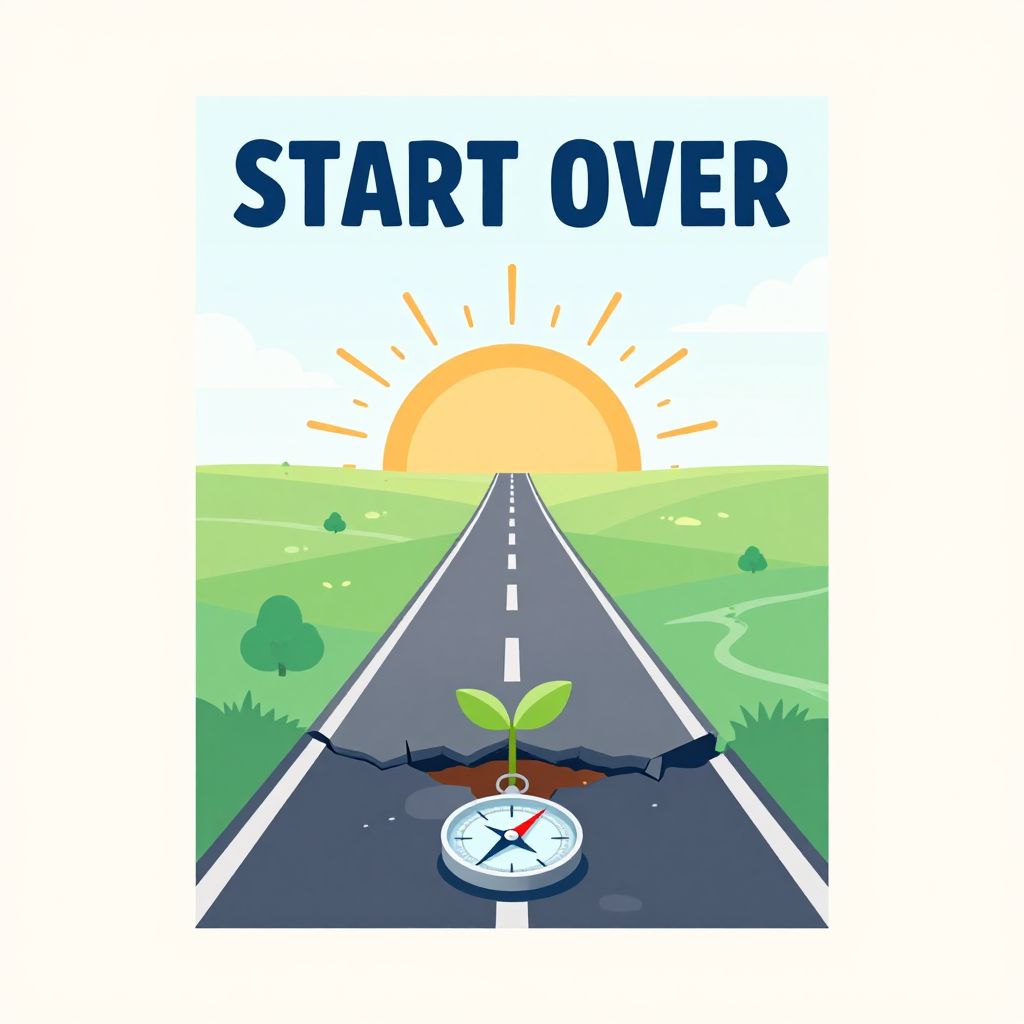
Starting over feels impossible when you carry the weight of past decisions, failed attempts, and the fear that you’ve already used up your best chances. Research in neuroplasticity confirms what many resist believing: your brain retains the capacity to rewire itself throughout your entire life, which means reinvention isn’t reserved for the young or the lucky.
The process of starting over requires more than motivation or a fresh calendar page. It demands a structured approach grounded in how humans actually change, not how we wish we could change.
How Do You Start Over in Life?
You start over in life by first accepting your current reality without judgment, then identifying one specific area to rebuild, and taking small, consistent actions that create visible progress. This approach works because it bypasses the paralysis of trying to change everything at once while building the momentum that sustains long-term transformation.
1. Accept Where You Actually Are
Acceptance doesn’t mean approval. It means you stop arguing with reality long enough to see it clearly.
Psychologists call this radical acceptance, a concept from Dialectical Behavior Therapy that separates facts from the stories you tell about those facts. You might be unemployed, divorced, or stuck in a career that drains you, but the emotional weight you carry often comes from resisting these truths rather than from the truths themselves.
Most people skip this step because it feels passive. They want to leap directly into action, into fixing, into becoming someone new.
But you can’t navigate from a location you refuse to acknowledge. GPS doesn’t work if you lie about your starting point.
2. Identify One Specific Area to Rebuild
The instinct when starting over is to overhaul everything simultaneously: career, relationships, health, finances, living situation. This approach fails consistently because willpower is a finite resource, as demonstrated in Roy Baumeister’s research on ego depletion.
Choose one domain that, if improved, would create the most meaningful shift in your daily life. Not the area that sounds most impressive or that others think you should prioritize, but the one that genuinely matters to you right now.
Health might unlock energy that makes career changes possible. Financial stability might reduce the anxiety that sabotages your relationships.
The order matters less than the singularity of focus. You’re not abandoning other areas; you’re acknowledging that sequential change builds more reliably than simultaneous transformation.
3. Define Success in Behavioral Terms
Abstract goals like “be happier” or “find purpose” give you nothing concrete to work toward. Your brain needs specific, observable actions to execute.
Instead of “get healthier,” define it as “walk 20 minutes each morning before work.” Instead of “improve my career,” specify “apply to three jobs each week” or “complete one professional certification by June.”
Behavioral specificity removes the guesswork that kills momentum. You know exactly what counts as progress, which means you know exactly when you’ve succeeded each day.
4. Remove Friction from the New Behavior
Good intentions collapse under the weight of inconvenience. Stanford researcher BJ Fogg found that behavior happens when motivation, ability, and a prompt converge at the same moment.
Most people try to increase motivation when they should be decreasing friction. Make the desired behavior so easy that motivation becomes almost irrelevant.
If you want to exercise in the morning, sleep in your workout clothes. If you want to eat better, remove junk food from your home rather than relying on willpower to resist it.
The path of least resistance should lead toward your goal, not away from it. Shape your environment to make the right choice the easy choice.
5. Track Visible Progress
Your brain responds powerfully to evidence of forward movement. Visual progress tracking activates the same reward circuits that reinforce habit formation, according to research in behavioral psychology.
Use a calendar and mark an X for each day you complete your target behavior. The chain of X marks becomes something you don’t want to break.
Or track metrics that matter: money saved, pounds lost, job applications submitted, days without a destructive habit. The format matters less than the visibility.
Progress you can see convinces the part of your brain that doubts whether change is actually happening. It turns abstract effort into concrete proof.
Why Most Restart Attempts Fail
Waiting for the Perfect Moment
You tell yourself you’ll start over when circumstances align: after the holidays, when work slows down, once you have more money saved, when you feel more ready. The perfect moment is a mirage that retreats as you approach it.
Readiness is something you build through action, not something you wait to feel. The research on action preceding motivation confirms this: behavior change often comes before emotional readiness, not after.
Messy starts outperform delayed perfection every time. Have you ever noticed that the cleanest plans often produce the weakest results?
Comparing Your Beginning to Someone Else’s Middle
Social comparison is poison when you’re rebuilding. You measure your first shaky steps against someone else’s polished outcome and conclude you’re failing.
Theodore Roosevelt’s observation that “comparison is the thief of joy” understates the problem. Comparison doesn’t just steal joy; it steals momentum by convincing you that your progress doesn’t count because someone else is further ahead.
The only comparison that serves you is between who you were yesterday and who you are today. That measurement tells you everything you need to know about direction.
Trying to Change Identity Before Changing Behavior
Many self-help approaches suggest you start by changing how you see yourself: adopt the identity of a healthy person, a successful person, a confident person. This reverses the actual sequence of sustainable change.
Identity follows behavior far more reliably than behavior follows identity. You become a runner by running repeatedly, not by declaring yourself a runner and hoping the behavior follows.
James Clear’s research on habit formation shows that small, repeated actions accumulate into identity shifts over time. Each action casts a vote for the type of person you’re becoming.
Stop trying to believe your way into new behaviors. Act your way into new beliefs instead.
Underestimating the Extinction Burst
When you start changing, things often get worse before they get better. Psychologists call this an extinction burst: the temporary intensification of an old behavior when you try to eliminate it.
Cravings spike when you quit a substance. Anxiety increases when you start setting boundaries.
Relationships that enabled your old patterns may push back against your changes. Your own mind will generate compelling reasons to return to familiar territory.
This intensification doesn’t mean you’re failing. It means the old pattern is fighting for survival before it dies.
Most people interpret the extinction burst as evidence that change isn’t working, so they quit right before the breakthrough. Knowing this pattern exists helps you endure it.
What Actually Sustains a Fresh Start
Building Systems Instead of Relying on Goals
Goals tell you where you want to end up. Systems tell you what to do each day to get there.
Goals are finite; systems are repeatable. You achieve a goal once, but a system serves you indefinitely.
If your goal is to lose 30 pounds, you might succeed through extreme restriction, then regain the weight when the goal is “completed.” If your system is to eat protein and vegetables at every meal, that pattern sustains the result long after you hit your target weight.
Focus on designing a process you can maintain rather than chasing an outcome you can’t sustain. The outcome becomes a byproduct of the system.
Connecting Daily Actions to Deeper Reasons
Surface-level motivation evaporates under pressure. You need to connect your daily behaviors to values and reasons that withstand temporary discomfort.
Why does this fresh start matter to you specifically? Not why it should matter, or why someone else thinks it matters, but why it genuinely matters to you.
Maybe you want to rebuild your health so you can keep up with your children. Maybe you want financial stability so you stop making decisions from a place of desperation.
Connecting action to purpose creates resilience when motivation fades. The research on self-determination theory shows that intrinsic motivation, grounded in personal values, sustains behavior far longer than extrinsic rewards.
Expecting Nonlinear Progress
Progress doesn’t follow a straight line upward. It moves in cycles, plateaus, and occasional backslides.
You’ll have strong weeks and weak weeks. Days when everything clicks and days when you barely hold on.
Regression to old patterns doesn’t erase your progress; it tests your commitment to the new ones. What matters is the overall trend, not the perfection of each individual day.
The Spiral Dynamics model in developmental psychology describes growth as a spiral rather than a ladder. You revisit similar challenges at higher levels of capability.
Stop interpreting setbacks as failures. They’re data points that show you where the system needs adjustment.
Creating Accountability Outside Your Own Mind
Private commitments are easier to abandon than public ones. External accountability dramatically increases follow-through, as demonstrated in studies on goal achievement and behavior change.
Tell someone specific what you’re doing and ask them to check in with you weekly. Join a group of people working toward similar changes.
Hire a coach, find a workout partner, or commit money you’ll lose if you don’t follow through. The format matters less than the existence of consequences outside your own internal negotiation.
Your brain is a skilled lawyer that can rationalize anything when no one else is watching. Accountability removes some of that negotiating room.
The Role of Environment in Reinvention
Proximity Shapes Possibility
You become like the people you spend the most time with. This isn’t motivational fluff; it’s documented in the Framingham Heart Study, which found that behaviors like obesity, smoking, and happiness spread through social networks with measurable consistency.
If everyone around you normalizes the patterns you’re trying to escape, you’re fighting an uphill battle against constant environmental cues. If you surround yourself with people already living the way you want to live, the new behavior starts to feel normal rather than exceptional.
You don’t need to abandon existing relationships, but you do need to add new ones that pull you forward. Seek out environments where your desired future is someone else’s present reality.
Physical Space Reflects Mental State
Cluttered, chaotic surroundings create cluttered, chaotic thinking. The research on environmental psychology confirms that physical disorder reduces cognitive performance and increases stress.
Starting over often requires clearing physical space: cleaning your living area, organizing your workspace, removing items connected to old identities or painful memories. This isn’t about aesthetics; it’s about reducing the cognitive load that drains your capacity for change.
A reset environment signals to your brain that something has shifted. It removes triggers connected to old patterns and creates room for new ones.
Location Changes Can Accelerate Identity Shifts
Moving to a new city or even a new neighborhood disrupts the automatic patterns that keep you stuck. When your environment changes, your brain can’t rely on autopilot, which creates openings for new behaviors to take root.
This doesn’t mean you must move to change, but it explains why fresh starts often feel easier in new locations. The absence of familiar triggers removes the constant reminders of who you used to be.
If relocation isn’t possible, create novelty within your current environment: take different routes, visit new places, break routines that keep you locked in old patterns. Disruption creates space for reinvention.
Rebuilding Relationships and Social Connections
Some Relationships Won’t Survive Your Growth
This is one of the hardest truths about starting over. Not everyone will celebrate your changes, because your transformation might threaten the role they assigned you in their own story.
Friends who bonded with you over shared complaints might pull away when you stop complaining. Family members invested in keeping you small might resist your expansion.
You can’t control how others respond to your growth. You can only decide whether you’ll shrink yourself to maintain relationships built on an old version of you.
Grieve the connections that don’t make the transition, but don’t abandon yourself to preserve them. Real relationships evolve with you rather than requiring you to stay frozen.
Invest in Connections That Reflect Your Direction
Seek out people who are solving problems you want to solve, building lives you admire, or developing capacities you want to develop. Proximity to growth-oriented people normalizes continuous improvement.
This doesn’t mean surrounding yourself with people who are “better” than you in some comparative sense. It means finding people who take their own development seriously and who see your potential rather than your past.
Communities centered on shared growth create permission structures for change. When everyone around you is stretching toward new versions of themselves, your own transformation stops feeling like an anomaly.
Rebuild Trust Through Consistent Action
If your past includes broken promises, unreliability, or behavior that damaged relationships, words alone won’t restore trust. Only sustained, consistent action over time rebuilds credibility.
Trust is earned in drops and lost in buckets, as the saying goes. You can’t rush the process of proving you’ve changed.
Some people may never trust you again, regardless of how completely you transform. That’s their right, and their boundary protects them.
Focus on being trustworthy rather than on being trusted. Do what you say you’ll do, keep your commitments, and let time do its work.
Starting Over After Major Loss or Failure
Grief Doesn’t Follow a Schedule
Whether you’re rebuilding after divorce, job loss, financial collapse, or any significant ending, you need to allow space for grief. Unprocessed loss leaks into everything you try to build next.
The stages of grief aren’t linear, and you don’t “complete” them and move on. You carry loss forward while also building something new.
Rushing past grief into forced positivity creates a shaky foundation. The research on complicated grief shows that avoiding or suppressing loss actually extends suffering rather than shortening it.
Make room for what you’ve lost while also taking steps toward what comes next. Both can coexist.
Failure Provides Data, Not Identity
The narrative you build about past failures determines whether they trap you or teach you. Failure is an event, not a characteristic.
Carol Dweck’s research on growth mindset demonstrates that people who view setbacks as opportunities to learn persist longer and achieve more than those who view setbacks as evidence of fixed inadequacy. The difference isn’t the failure itself but the story told about it.
What did the failure reveal about what doesn’t work? What assumptions proved wrong?
What would you do differently with the information you have now? Extract the lesson without absorbing the shame.
You Don’t Have to Explain Yourself to Everyone
People will ask what happened, why you’re making changes, what went wrong. You don’t owe everyone the full story of your restart.
Protect your process from people who don’t have the capacity to support it. Some questions come from genuine care; others come from curiosity, judgment, or the need to feel superior by comparison.
Develop a brief, honest response that closes the topic: “I’m rebuilding some things and focusing on what’s next.” Then redirect or disengage.
Save the deeper sharing for the few people who’ve earned access to your inner world. Everyone else gets the public-facing version.
The Timeline Question: How Long Does It Take?
Research Offers Ranges, Not Guarantees
The popular claim that habits form in 21 days comes from a misinterpretation of Dr. Maxwell Maltz’s work on self-image. Actual research by Phillippa Lally found that habit formation takes an average of 66 days, with significant variation depending on the complexity of the behavior.
Simple habits like drinking water after breakfast might solidify in three weeks. Complex behavioral patterns like financial discipline or emotional regulation might take six months or longer.
The timeline matters less than the consistency. Daily repetition, even imperfect, beats sporadic intensity every time.
Visible Results Lag Behind Invisible Progress
You might work hard for weeks or months before you see external evidence of change. This lag period discourages most people into quitting.
James Clear uses the metaphor of an ice cube in a warming room: nothing appears to happen at 25 degrees, 26 degrees, 27 degrees, then suddenly at 32 degrees it melts. The temperature increase was happening all along; the visible change came later.
Trust that invisible progress is still progress. The internal shifts precede the external results.
You’ll Know You’ve Turned the Corner When
The new behavior starts feeling easier than the old one. You reach for the healthy option without internal debate.
People who haven’t seen you in months comment on the change. External validation confirms what you’ve been building.
You catch yourself handling a situation differently than you would have six months ago. The contrast shows you how far you’ve actually come.
The finish line isn’t a destination; it’s the point where the new pattern becomes your new normal. You’re not trying to sustain it through willpower anymore; you’re just living it.
Final Thoughts on Beginning Again
Starting over doesn’t erase everything that came before. It incorporates past experience into a wiser, more intentional version of your life.
You bring forward what served you and leave behind what didn’t. The skills, strength, and resilience you built during difficult seasons become resources for what you’re building next.
Every ending contains the seeds of a new beginning, but only if you plant them. Waiting for life to restart itself keeps you stuck in the same patterns with different scenery.
Choose one area. Define one behavior. Take one step today.
The momentum you need doesn’t arrive before you start. It builds because you started.
Starting over isn’t about becoming someone you’ve never been. It’s about becoming who you’ve always had the capacity to be once you removed what was blocking the path.
For more guidance on personal growth and transformation, explore our resources on how to find yourself again and how to be the best version of yourself. These articles offer practical strategies for reconnecting with your authentic self and building the life you genuinely want to live.