
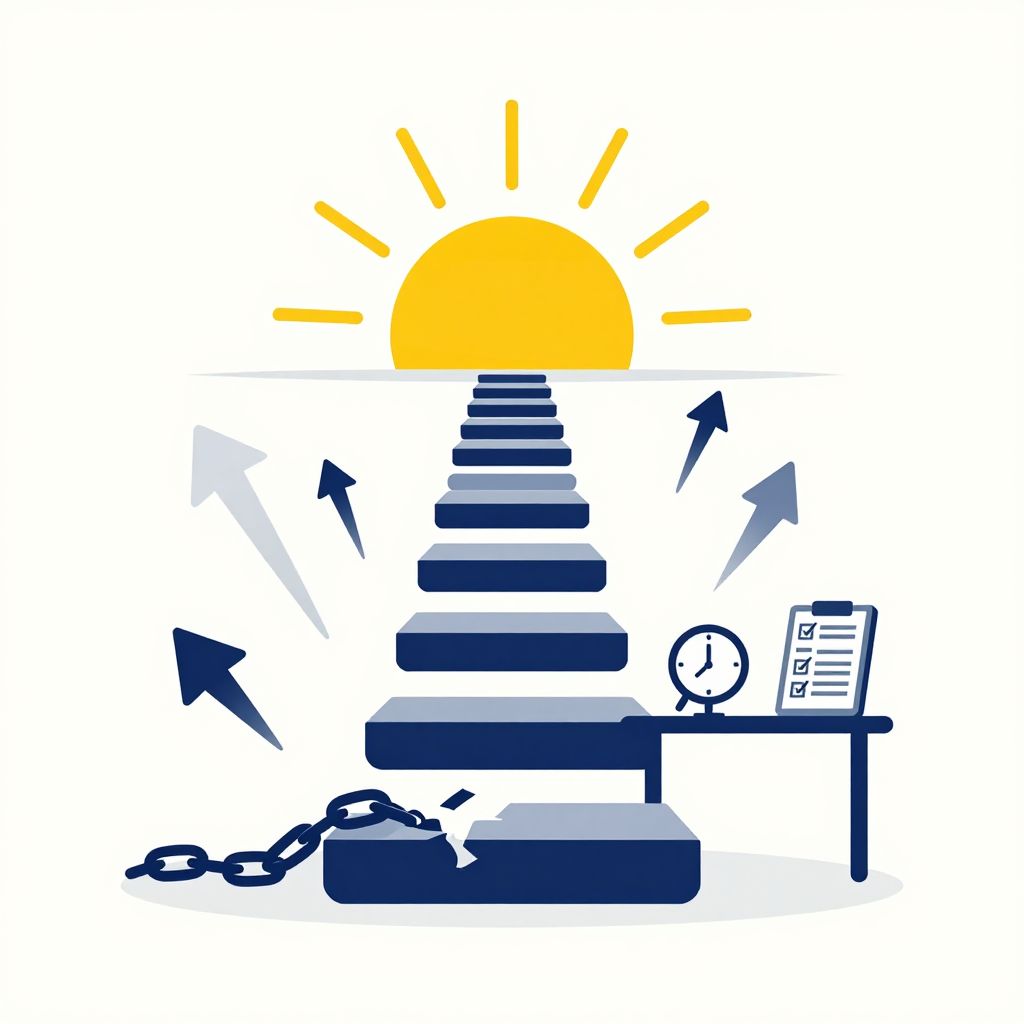
Laziness isn’t what most people think it is. The problem isn’t that you lack willpower or motivation—it’s that your brain operates on a simple rule: it avoids discomfort and seeks the path of least resistance. Research in behavioral psychology shows that what we label as laziness is often a mismatch between how we structure our environment and how our minds actually work.
This article walks you through the science of action, the psychology of resistance, and the practical systems that turn intention into consistent behavior.
How Do You Stop Being Lazy?
You stop being lazy by lowering the friction between you and the action you want to take. Structure your environment to make the desired behavior the easiest option, break tasks into smaller steps, and start before you feel ready—motivation follows action, not the other way around.
Understand That Motivation Follows Action
Most people wait to feel motivated before they start. This is backwards.
Neuroscience research shows that the brain’s reward centers activate after you begin a task, not before. Dopamine—the neurochemical tied to motivation—gets released as you make progress, not while you sit and think about making progress.
Action creates momentum. Momentum creates motivation.
Have you ever noticed how the hardest part of going to the gym is getting out the door, but once you’re there, the workout feels manageable? That’s not coincidence.
Lower the Activation Energy
Every behavior has what psychologists call “activation energy”—the amount of effort required to start. Laziness is often just high activation energy dressed up as a character flaw.
If you want to run in the morning, sleep in your workout clothes. If you want to eat healthier, pre-cut vegetables and put them at eye level in the fridge.
The easier you make the first step, the less resistance you’ll face. Your brain doesn’t care about your goals—it cares about conserving energy right now.
Why Your Brain Resists Action
The Default Mode Network
Your brain has a network called the Default Mode Network (DMN) that activates when you’re at rest. The DMN is incredibly energy-efficient, which is why your brain prefers it.
When you try to shift from rest to action, your brain registers this as a threat to its energy reserves. It pushes back with feelings of resistance, discomfort, or the sudden urge to check your phone.
This isn’t laziness. It’s biology.
Decision Fatigue Drains Your Capacity
Every decision you make throughout the day depletes a finite mental resource. By the time evening arrives, your ability to override impulses and choose difficult tasks drops significantly.
Research by psychologist Roy Baumeister on ego depletion shows that willpower functions like a muscle—it tires with use. This is why you can start the day with good intentions and end it on the couch scrolling.
The solution isn’t more willpower. It’s fewer decisions.
What Actually Builds Consistency
1. Shrink the Task Until It Feels Ridiculous
If a task feels too big to start, make it smaller. Don’t commit to writing for an hour—commit to writing one sentence.
Stanford behavior scientist BJ Fogg calls this “scaling back to the minimum viable action.” The goal is to remove the psychological weight that prevents you from starting.
One sentence often turns into a paragraph. One push-up often turns into ten.
The magic isn’t in the size of the action—it’s in the consistency of showing up.
2. Anchor New Habits to Existing Ones
Your brain loves patterns. When you attach a new behavior to something you already do automatically, you borrow the existing habit’s momentum.
This is called “habit stacking.” After you pour your morning coffee, you do five minutes of stretching. After you brush your teeth at night, you lay out tomorrow’s clothes.
The existing habit becomes the trigger. The new behavior becomes the response.
3. Design Your Environment, Don’t Depend on Discipline
Discipline is overrated. Environment design is underrated.
A study published in the journal Personality and Social Psychology Bulletin found that people who exercised consistently didn’t have more self-control—they structured their lives so that exercising required less self-control.
Put your phone in another room when you work. Keep junk food out of the house entirely.
You can’t rely on willpower to win against a bag of chips sitting three feet away. Remove the chips.
How to Handle the Emotional Side of Inaction
Recognize Avoidance as a Signal
Sometimes what looks like laziness is actually avoidance of something uncomfortable—fear of failure, perfectionism, or uncertainty about where to start. Your brain protects you from discomfort by keeping you stuck in inaction.
When you feel resistance, pause and ask: what am I actually avoiding here? Often, naming the fear reduces its power.
Separate Identity from Behavior
Calling yourself lazy turns a behavior into an identity. Identities are rigid; behaviors are flexible.
You’re not a lazy person. You’re a person who hasn’t yet built the systems that make action easier than inaction.
This distinction matters. It keeps the door open for change.
Stop Waiting for the Perfect Moment
There is no perfect moment. Waiting for clarity, readiness, or the right mood is just procrastination with better PR.
Clarity comes from action, not before it. You learn what works by doing it badly first, then adjusting.
The Role of Rest and Recovery
Not All Inaction Is Laziness
Sometimes your body and mind genuinely need rest. Rest is not the opposite of productivity—it’s a requirement for it.
Chronic stress, poor sleep, and burnout all masquerade as laziness. If you’ve been pushing hard for weeks and suddenly can’t get off the couch, that’s not a character flaw—it’s your nervous system asking for recovery.
Listen to it.
Build Recovery Into Your Routine
High performers don’t work harder—they recover smarter. Rest is a strategic tool, not a guilty indulgence.
Schedule downtime the same way you schedule work. Protect your sleep like it’s a meeting with your future self (because it is).
A rested brain makes better decisions, resists less, and starts faster.
Practical Systems to Build Momentum
1. Use the Two-Minute Rule
If a task takes less than two minutes, do it immediately. This prevents small tasks from piling up and creating mental clutter.
Mental clutter drains energy. Each unfinished task sits in your working memory, pulling focus and creating low-level stress.
Clear the small things fast. Save your energy for what actually matters.
2. Track Behavior, Not Outcomes
Outcomes take time. Behavior is immediate.
Track whether you showed up, not whether you succeeded. Did you write today? Did you move your body? Did you start the thing you’ve been avoiding?
Tracking behavior builds identity. Over time, you become someone who shows up—and that identity carries you further than any single outcome ever could.
3. Create External Accountability
Humans are social creatures. We follow through on commitments to others more reliably than commitments to ourselves.
Tell a friend what you’re working on. Join a group with shared goals.
External accountability doesn’t mean you’re weak—it means you understand how your brain works and you’re using that knowledge strategically.
What Happens When You Slip
Expect Setbacks and Plan for Them
You will miss days. You will fall back into old patterns.
The difference between people who change and people who don’t isn’t that the first group never fails—it’s that they get back on track faster. Research on behavior change shows that the speed of your return matters more than the perfection of your streak.
One missed day doesn’t undo weeks of progress. Two missed days is just getting back to normal.
Three starts to rebuild the old pattern. Get back in before three.
Don’t Let Guilt Compound the Problem
Guilt is a terrible motivator. It might get you moving once, but it won’t sustain you.
Shame makes you avoid the thing you feel bad about. Compassion makes you face it, learn from it, and adjust.
Treat yourself like someone you’re trying to help, not someone you’re trying to punish.
The Long Game
Small Habits Compound Over Time
You won’t see results in a day, or even a week. Consistency over time is what separates temporary change from lasting transformation.
James Clear, author of Atomic Habits, uses the metaphor of ice melting: if you heat a room from 25 to 31 degrees, nothing happens. At 32 degrees, the ice melts.
Your efforts aren’t wasted when you don’t see immediate results. They’re accumulating beneath the surface.
Focus on Systems, Not Goals
Goals tell you where you want to go. Systems get you there.
A goal is running a marathon; a system is running three times a week. The system is what you control. The system is what builds the person who achieves the goal.
Fall in love with the system. The results will follow.
Final Thoughts
Laziness isn’t a permanent condition—it’s a symptom of mismatched systems, high activation energy, and a brain doing exactly what it evolved to do: conserve resources. You don’t need to fix yourself; you need to redesign how you interact with your goals.
Lower the friction. Start before you feel ready. Track the behavior, not just the outcome.
The version of yourself that takes action consistently isn’t someone else—it’s you, with better systems. Build those systems today.
If you’re looking to deepen your understanding of productivity and self-discipline, you might find it helpful to explore strategies on how to stop being lazy or learn how to focus on yourself amid life’s many distractions. Each step you take toward understanding your patterns brings you closer to the clarity and momentum you’re seeking.